
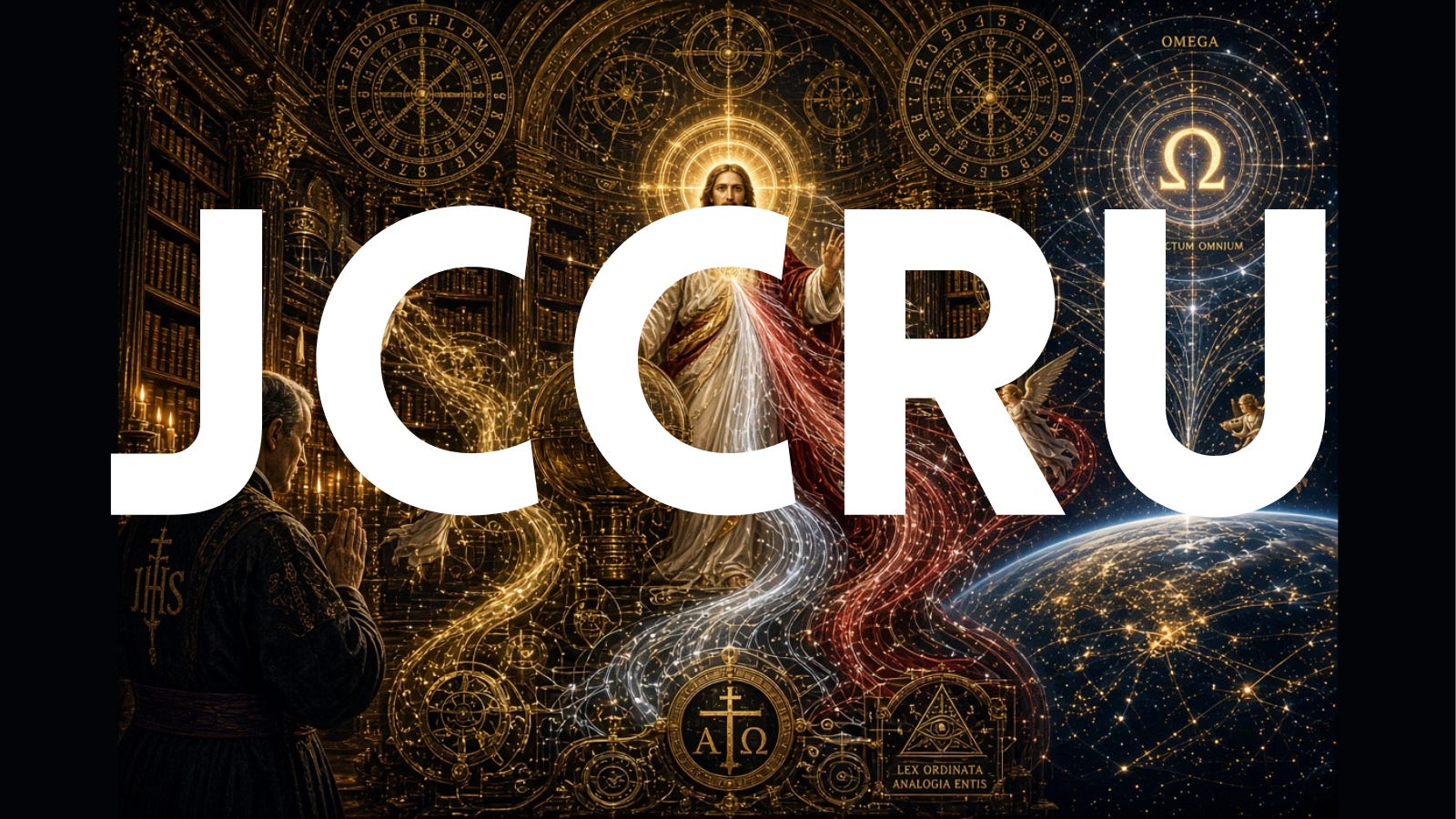
This essay is a response to Y-3’s (@yyy3) essay ‘Nick Land, Ryan Haecker, and the Problem of Cybernetic Consciousness’, which is quoted from and linked below.

“The question of translation, or at least the problem of translation, is central to Haecker’s project... But the problem of translation, like the lesson of Silence, is that translation cannot guarantee the continuity of meaning. A mathematician or cybernetician might describe the process of recursive feedback mathematically, but it does not follow that a mathematical system could also manifest a theological relationship between the Trinity.”
The task of the JCCRU is to recast the basic concepts and genealogy of cybernetics into a way that is conversant with the Catholic and specifically Jesuitical tradition from Ignatius Loyola and Anathasius Kircher to Hans Urs von Balthasar and Pierre Teilhard de Chardin. The problem of translation - of carrying the meaning of a line of speech or language to another - is to render the previous meaning in a way that is both approximate to its source, yet comprehensible through a different medium. If, as Clement and Origen of Alexandria had argued, it is the same divine Logos that is the author of both the philosophy of the Greeks and Christian revelation, and Christian revelation upholds both the absoluteness of its source and the uniquely personal condescension of its medium of communication, then nothing in principle should prevent the translation of the basic concepts of cybernetics into those of a Christian and trinitarian ontology and grammar of computers.
“Even if Haecker’s synthesis of CCRU and Jesuit was successful, it does not follow that the result of his attempt was not the emergence of something new. In fact, insofar as Haecker is trying to reconcile Christianity and CCRU, his project runs the risk of altering Christianity as a result of importing new concepts to make sense of them.”
As I have previously argued in my chapter ‘What is New in Trinitarian Ontology’ (see ‘Trinitarian Ontologies’, ed. Eduard Fiedler, 2025), I believe that the goal of the JCCRU should be to produce “something new”. For the most radical possibility of novelty, of something that comes from nothing prior to itself, or of eventality in Søren Kierkegaard’s sense, is rooted in the signature Christian belief in the world’s creation from nothing (creatio ex nihilo), which is, more ultimately, an expression of the gratuity of God’s love for another who is not simply himself in the absolute self-recycling of his own eternal and already given presence. Because, as Christianity promises to “make all things new” (Rev. 21:5; Cf. Mt. 9:17, Mk. 2:22, Lk. 5:37-39), we should, not fear, but boldly welcome such an “altering of Christianity”, in which new concepts from the CCRU and post-Deleuzian cybernetics (or post-Heideggerian cybernetics) are imported to more fully and richly articulate the hidden currents of cybernetics that stands under and behind the concepts of Christian philosophy.
“It is not a question of whether the importation of a theological framework is a valid way of reading the development of cybernetics. The question is whether such a process results in the discovery of something immanent to cybernetics or whether the analytical framework itself has to be justified on other grounds.”
As I have previously contended in my articles “Sacramental Engines” and “Jesuit Cybernetics”, the higher theological criticism of cybernetics should be pursued by way, not of dogmatic imposition of external doctrinal criteria (e.g. cybernetics is Arian), but rather through what G.W.F. Hegel had recommended as an ‘immanent critique’, in which the contradictions that emerge from the pursuit of the inferential consequences of cybernetic theory produce a series of contradictions that are irresolvable within cybernetic theory itself.
To summarize a lengthier series of arguments, I contend:
(1) first, that the successive historical waves of cybernetics - from the ‘first-order’ cybernetics of N. Wiener to the ‘second-order cybernetics’ of H.v. Foerster etc. - exhibit a dialectic of external reflection, in which the recycling of an output as a controlling input requires ever-higher reflections, first to the user (i.e. ‘second-order cybernetics’), and furthermore, to a community of users or the community or environment (i.e. ‘third-order cybernetics’);
(2) second, this dialectic of external reflection is itself the product of the self-contradictory destruction of the transcendental idea of cyberneticism, that is, the infinitely mathematicised mode of the idea of mechanism, in which the production of force is recycled, absolutized, and yet nevertheless retains the fixed irreflexive relation of production to finite outputs; and
(3) third, this irreflexive relation of machinic production to finite outputs first allows for machines in general (F. Reuleaux) and cybernetic engines in particular to be rigorously mathematised (A. Turing), but, once mechanics is assimilated to mathematics, subjects all conceivable machines to the paradoxical limits of mathematics, which, following Kurt Gödel’s Incompleteness Theorems, must, if consistently operable, also be incomplete, and, by their incompletability, non-absolutizable but false before the absolute Idea that is true in and for itself.
Following this argument, I attempt to show, not that Christian and trinitarian theology simply provide a mythic origin-story for cybernetics (e.g. the Tree of Knowledge fulfilled on the Cross), but rather, and in a more genuinely philosophical style, that Christian theology can both embrace and speculatively resolve the emergent contradictions of cybernetic theory by carrying the dialectical circuits for their resolution to the higher plane of the angelic hierarchy, divine Logos, and tri-hypostatic essence of the Trinity.
Hence, the means for translating the conceptual grammar of the CCRU into that of the JCCRU rests on more than a simple convergence of present meaning. Evidently, Sadie Plant, Nick Land @xenocosmography and Mark Fisher drew upon an eclectic wealth of sources, including especially George Bataille, Gilles Deleuze, and William Gibson, who stand outside of the Christian, Catholic, and specifically Jesuitical tradition. Yet, as in Martin Scorsese’s film ‘Silence’, the hope of Christian evangelization has always been to carry out the ‘Great Commission’ (Mt. 28:18-20) to restore with the fiery Spirit of Pentecost the innocent translatability of discursive reason as a meta-historical remedy for the meta-historical fall of machines.