Contra Strauss I
A response to Leo Strauss's 'Reason and Revelation' (1948)

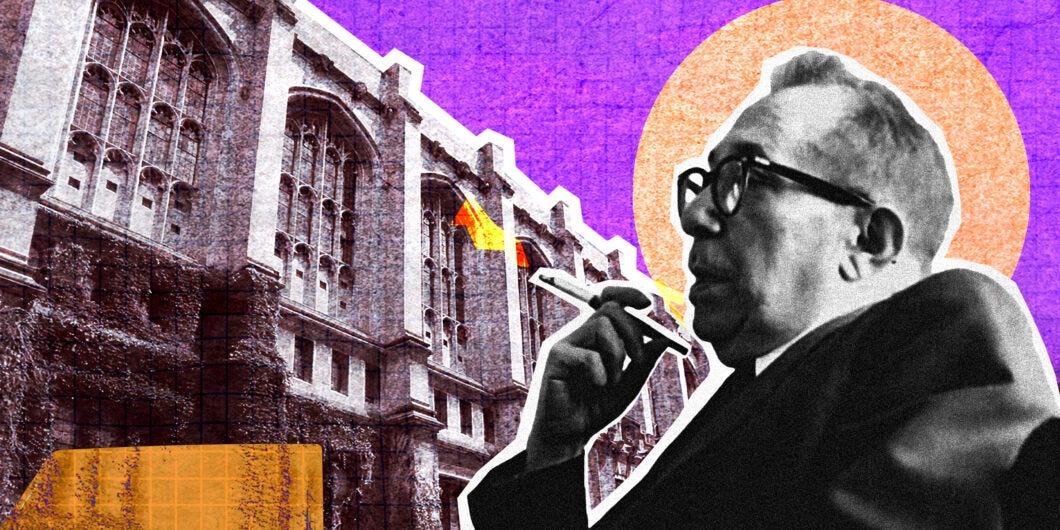
Why does Leo Strauss oppose reason to revelation?
This opposition arises from the assumption of the sufficiency of natural reason, that is, reason absent of originary divine creative grace. Yet, to suppose that reason lacks grace from the beginning is also to imply that reason is not perfected by grace in the end, and stands forever opposed to revelation.
In contrast to the 20th-century Neo-Origenians, such as Henri De Lubac and Hans Urs von Balthasar, Strauss assumes a Neo-Stoic posture of immanently totalizing rationality. Once faith is suspended entirely above the neutral sphere of reason, it can only be answered to an evental fact of discursively empty brute experience, for which no argument is either needed or sufficient. Yet, as Strauss acknowledges, “Paul clearly teaches”, to the contrary, that the unbeliever is not excusable, not because faith is a fact like any other, but rather because the possibility of faith arises in response to what is shown in revelation, corporately, and through sensible echoes in the corporal charity of the Church.
Once revelation is suspended above reason, it can, as Strauss indicates, only operate against reason by a performing a negative or indirect (apagogic) argument for the absurdity of philosophy, ala Al Ghazali. Yet if this sceptical attack succeeds, even this argument fails, and the original opposition remains between revelation and reason.
What, however, Strauss fails to consider is the Pauline Christian claim to the mutual immanence of reason and revelation, where, in virtue of the divine Logos become flesh in Jesus, reason, as Clement claims, begins with faith, and faith, as Origen maintains, is perfected by the exercise of reason to know it more.
Strauss’s fundamental mistake - one common to Spinoza and so many of the ‘moderns’ - is to inconsistently hold reason to be sufficient for its own absolute knowledge, and yet equally to suspend its satisfaction from a voluntary act that pivots upon a discursively irreducible encounter with a religious event.
All this quite obviously refuses the Christian alternative, where, like doubting Thomas, the event that we encounter is more tactile, embodied, and real than an mere alethic choice to believe or not, in a rapturous accompaniment with the real that variously extends across the planes of dialogic knowing.
Strauss here collapses the infinite circuits of dialectic in Plato and Aristotle, who, like Plato, systematically retains dialectic in the divine Nous, with finite inferences, in which, for instance, a syllogism (demonstration) cannot presuppose its conclusion (demonstrandum).
With this collapse, it cannot be denied that God cannot be demonstrated from the phenomena. Yet no theologian until perhaps William Paley in the modern era had ever believed so. For, as Hegel famously argues in the Preface to the Phenomenology of Spirit, the idea or name of God cannot simply be asserted as a premise that is presupposed. Rather, the ever-greater mystery of God ‘beyond intelligence’ calls for an equally ever-greater participation of created intelligences in the gift of their creation.
Strauss’s reluctance to recognize the theistic kernel of Plato and Aristotle arguably here results from his all-too modern and unwittingly historicizing conception of the elementary and inescapable forms of knowing, which, ala Spinoza and Locke, he assumes must either be quasi-empirical, or systematically totalizing to be true.
In a fascinating theo-political twist, Strauss’s famous advocacy of Plato’s ‘noble lie’ is, here, shown to be a consequence of the fundamental tension between reason and revelation, the acidic consequences of reason contra revelation, and the suspension by the philosopher of the beliefs that must be urgently decided by politics.
Were, to the contrary, reason and revelation to be ‘intertwined’ (as Origen of Alexandria maintained), this fundamental tension, of revelation suspended before sceptical reason, could be unwound and reassembled, as Andrew Willard Jones has illustrated, in a more radically sacramental politics.
Occasionally in his unpublished remarks, Strauss shows his cards too soon, and reveals, as his fundamental dogma, that the philosophical or ‘Socratic’ way of life is, in a way reminiscent of Pierre Hadot, a rationally unwarranted paradoxical choice, which, contrary to the religious and the social, asserts itself as universal aim of totalizing dialogic mastery of all particular sites of religious experience and social or political life.
Strauss claims the essence of philosophy to be the epoché, that is, the “suspense of judgment regarding the most fundamental questions”, in a fundamental ‘scepticism’ that lacks ultimate resolution. This aporetic view of philosophy suspends the resolution of “the answers themselves” in “two contradictory answers” in an antinomial dialectic of divided and contradictory opposites. It is, he writes, “a disputation rather than decisive”, in the sense of a decision that resolves the contradictory opposites of argument.
In suspending any such ultimate decision, Strauss obstructs any further dialectical analysis of the prior conditions of such a contradictory opposition, in a negative dialectic of unproductive skepticism. In obstructing dialectical analysis, Strauss more ultimately suspends the Hegelian Concept (Begriff), as the concrete universal center in which all aporetic contradictions are immanently resolved, in favor of a plural conceptuality, “the anarchy of the systems”, in which multiple conflicting lines of argument can be upheld in their antinominal and agonic plenitude.
In a restatement of the founding opposition between reason and revelation, Strauss states that “the Biblical solution [to the problem posed by the contradictions between the various divine laws] is diametrically opposed to the philosophic solution.” For, as Strauss narrates, “the Biblical account of the first things”, that is, the protology of the Book of Genesis from “the creation of heaven and earth to Abraham”, represents “one particular possible code” that “can be the only divine code that ever was and ever will be” - one particular but necessary or essential protology.
Contrary to Philo, Clement, and the Alexandrian synthesis of Origen of Alexandria, as well as his Cappadocian heirs culminating in Maximus the Confessor, Strauss claims that this Biblical protology “rejects as illegitimate the possibility which came to its maturity in Greek philosophy: the possibility that man can find his happiness, or his peace, by eating of the fruit of the tree of knowledge.” In a Gnostic style, Strauss claims the fruit of the tree of knowledge to represent the desire to know in Greek philosophy that was refused by the Bible: “When the classical philosophers conceive of man’s desire to know as his highest natural desire, the Bible protests by asserting that this desire is a temptation.”
Strauss’ fundamental conflict between the Bible and Greek philosophy is the conflict between gnosis and anti-gnosis, that is, between a desire to know and the suspension of that desire by faith that a code of law should be obeyed but not known. He writes: “The Bible thus offers the only challenge to the claim of philosophy which can reasonably be made.” The challenge of the Bible is, in short, a story of anti-gnosis, in which, ala Kierkegaard, Abraham’s faith without knowledge (e.g. the sacrifice of Isaac), authorizes the suspension of the desire for knowledge in an ascetic practice of ritual obligations in obedience to divine law - especially the Jewish law. The Christian third way that Strauss here refuses is that which Clement had named ‘Christian gnosis’, in which Christ the incarnate Logos shows, in his theandric unity, and as a sacrificial lamb substitute for Isaac, the radically human way for us to know of God as God knows all things.
The esoteric third way that results from this fundamental conflict of Biblical anti-gnosis and Greek gnosis is must be an oscillation of divinely justified faith without knowledge and incipiently nihilistic knowledge without faith. For the human desire to know is not obstructed from within the ways that we know, through logic, poetry, or politics, but rather and only from without, that is, from a story that calls its readers to obey an extrinsically imposed divine law that prohibits as deathly knowing otherwise.
Alternatively, as Strauss indicates in his essay ‘German Nihilism’, this human desire to know, culminates, as Weber warned of Comte in a scientific positivism that preserves no essential value for the human person except as an instrument of a totalizing cybernetic engine of capitalist production, or in the anti-positivism of Nietzsche and Heidegger, which, as for Nietzsche, such a complete science is an idol that wipes away all values, or, as for Heidegger, the basic concepts of metaphysics or phenomenology contain no truth except as a call to the questioning of the meaning of man’s being.
Strauss’s esoteric third way between philosophical gnosis and Biblical anti-gnosis will be labeled ‘Socratic’, especially in the style of the Academic sceptics, who, contrary to the 3rd-Century BC Peripatetics and the Stoics, advocated a religious way of life (Hadot), in which the conclusions of philosophical science are suspended in a continuous questioning of the fundamental assumptions of the first things, or principles. It is important to recognize here that Strauss’s sceptical suspension of the Biblical challenge is not ipso facto atheistic. For it doesn’t claim, ala Voltaire, that philosophy can disprove the existence of God, or invalidate the divine law. Rather, it suspends, as anti-gnostic and inhumanist, the dogmatic necessity of the law for denying the human desire to know.
Nevertheless, the religious suspicions of Strauss’s resistance to divine law are not altogether unfounded. For in advancing this esoteric skeptical religious way of life, he does in fact recommend a Neo-Hellenistic religious path, which, like the academic sceptics, suspends the essence of divine law, and holds Biblical revelation to be an obstacle to human reason. From the standpoint of Christian orthodoxy since the Council of Chalcedon, such a suspension of divine law heretically denies the theandric unity of Christ who, as God and man, knows absolutely as a human, and shows, in the ‘Life’ of Christ, a corresponding way to absolute knowing, that is, ‘Christian gnosis’.
This conflict between Neo-Hellenistic academic skepticism and Christian gnosis raises a higher philosophical question concerning the legitimacy of Strauss’s concept of philosophy in general, and his political philosophy in particular. For, throughout his essay ‘Reason and Revelation’, Strauss insists that philosophy stands opposed to the religion of the Bible because, as Heinrich Meier has argued, the compulsory obligatoriness of the divine law is discursively inscrutable to human reason, divine law stands above philosophical reason, and yet it is only through philosophy that the human desire to know without foundations or finality can be satisfied. The final satisfaction of philosophy, what François Laruelle calls the ‘determination-in-the-last-instance’, is here suspended before a pragmatically oscillating pivot of exoteric obedience to divine and human law, but a esoteric questioning of its fundamental assumptions that must forever remain fixed on the problematics of its questioning.
In refusing, ala Hegel, the dialectical analysis of the conditions of its proliferating problemata, it drifts ineluctably towards the reification of those conditions, towards a dogmatic insistence that skepticism can only be maintained by refusing all final answers, and thereby to a dogmatic refusal of the Biblical option that is thereby also a religious answer to doubts about all such fundamental assumptions. In response to Christianity, it drifts ineluctably towards a reification of dogmatic skepticism, tantamount to atheism, towards the orthodox Chalcedonian hypostatic or theandric union of God and man that reflexively authorizes new avenues of speculative theological answers to philosophical questioning.
However, in rejecting theology, it also fatally undermines philosophy in general, and political philosophy in particular. For, if, for reasons of a Neo-Hellenistic academic skepticism with Nietzschean-Heideggerian characteristics, final answers to philosophical questioning of fundamental assumptions are dogmatically refused in advance, the proliferating problemata that have become emblematic of the Straussian school of political theory (e.g. their ever-multiplying conflicting interpretations of Plato), cannot be answered, not because no answer may be available, but rather and more problematically because the very possibility of such answers have been refused in advance.
This refusal of answerability to questioning reiterates the basic problem of academic skepticism: in refusing answers to problems, it refuses not only the answerability but also the very problematic-ness of the problems that it claims to raise. For, as Socrates insists, problems should only be raised in search of answers, so that ignorance may lead to knowledge, and the soul may be perfected in knowing itself. By contrast, a problem that is raised without the possibility of an answer, an unanswerable problem, is no problem at all, but rather only the gesture of a question that lacks genuine problematic-ness. Yet if the Straussian style of questioning can be observed to lack not only gnostic answerability but sceptical problematic-ness, it can no longer be considered genuinely sceptical, or genuinely Socratic.
Contrary to the aspiration of Strauss, the Straussian school of political theory can be observed to exhibit a historical drift from academic skepticism to dogmatism, in which the dogma of unanswerable questioning is equally a uproblematical gesture of raising questions without possible answers, obstructing the search for answers that defines the gnosis of philosophy, and holding political theory in an anti-gnosistic problematic of its own making. Ironically, political theory in the Straussian style becomes not more but less philosophical by advocating a Neo-Hellenistic and Heideggerian styles of academic scepticism that drifts into a dogmatic atheism of empty questioning.
If, as this essay has argued, Strauss’s refusal of revelation leads to an un-philosophical political theory, then why, we should ask, has Straussianism continued to grow (mostly in American political science departments), despite the many devastating criticism from figures such as Quentin Skinner to Paul Gottfried, which have, generation after generation, raised fundamental logical, hermeneutical, scholarly and political challenges to this movement? The answer to this question may be less philosophical and more political. For the success of an intellectual movement can often be artificially sustained by the buoyancy of political support, even while it lacks intellectual legitimacy.
This is not to suggest, as has often been fancifully imagined, that the students of Strauss, such as Paul Wolfowitz, have ascended to the heights of government power, and have exercised that power to support an academic cabal of Straussian professors. Rather, what I wish to suggest is that there may exists an alignment between a Nietzschean will-to-power at the aporetic indecisions of academic skepticism and strands of techno-oligarchic conservativism, which, explicitly in the case of Peter Thiel and his proteges, seek academic or religious justification for Schmittean violence in excess of liberal protocols of procedural government.
Contrary to the aspiration of Strauss, the Straussian movement can, in this way, be observed to have descended from the heavenly ideals of Socrates into an unphilosophical dogmatism that can be more easily captured by sophistical forces of calculative reason and technocratic control on a supranational scale.