Contra Strauss II
The No True Straussian Fallacy

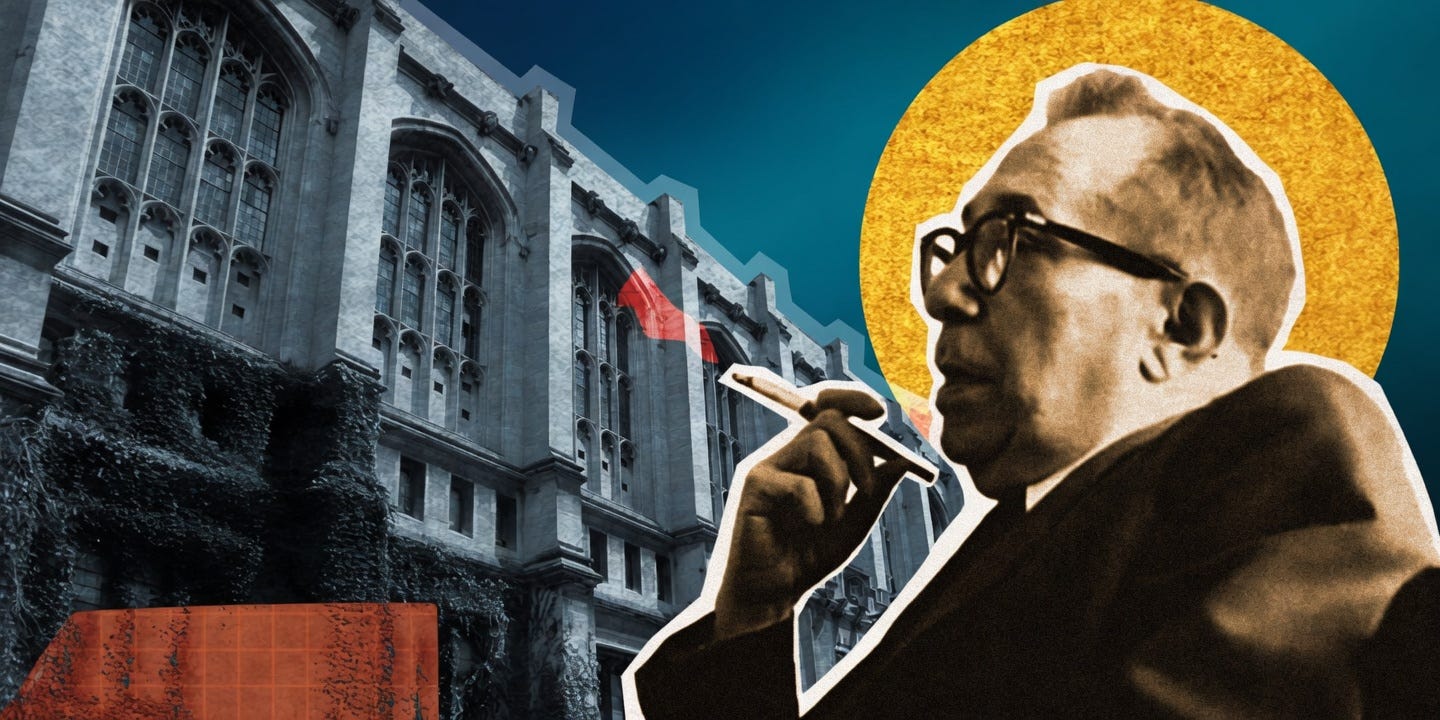
The typical refrain of Straussians to criticism is something akin to the ‘No True Scotsman’ fallacy.
To critique Strauss is to misunderstand Strauss, because a true Straussian, or Strauss himself, would surely never have believed such a foolish ‘caricature’.
Yet this same refrain exhibits a slippery pattern of argument designed to disallow legitimate criticism.
When, in the history of philosophy, a new school of thought emerges, the first question that is asked is:
‘What does this new school believe?’
Doxographies, such as Diogenes Laërtius’s ‘Lives and Opinions of Eminent Philosophers’, provide initial but admittedly imperfect answers.
Hence, Aristotle writes of Plato (and the Platonists) that he was distinguished from the Pythagoreans by his belief in self-subsisting forms that are separate from things in the material world. (Strauss disagrees)
“It is true that he [Plato] too supposes that numbers are both these magnitudes and their causes; but in his view the causative numbers are intelligible and the others sensible.” (Metaphysics, I.6., 987b29–33)
When, however, doxographers have attempted to summarize the teachings of Leo Strauss and his followers, these summaries are often dismissed as mischaracterizations at best or ‘caricatures’ at worst.
Why is this?
One explanation is that Strauss’s belief in esoteric writing renders his own writings resistant to an exoteric summarization for common readers.
Another explanation is that Strauss tacitly assumes a sub-Heideggerian immanent ‘Destruktion’ of any formulaic translation of concepts into propositions.
Or, another explanation is that as soon as the old master’s cloak is removed, the wizard loses his power. For that esoteric protocol was designed precisely to dissemble the underlying incoherence of his thought.
This embarrassment is most discernible in Strauss’s hermeneutic. Like Gadamer, he follows Heidegger’s ‘Destruktion’ of the metaphysical infrastructure- scientific and otherwise- of traditional doxographies.
Yet, in contrast to the Alexandrian conclusion of ‘Truth and Method’, Strauss refuses to ground his ‘hermeneutical circle’ in the divine Logos, and rather chooses to invest it in a roster of mythical personae, such as the many-sided portrait of Socrates, who stand as constructed archetypes of hermeneutical functions.
Dramatology may thus appear to supersede logic and metaphysics, but only so because the progress of both sciences has been suspended in advance.
When, however, one asks why any one archetypal construction should be privileged over another, or what could be the universal justification for any particular line of interpretation, the Straussian can only circle around upon these same confected personae, their own idiosyncratic readings, or perhaps finally the authority of Strauss and his likeminded devotees.
These tactics do thwart criticism, but only for those who have been hoodwinked by a more devious magician.
If we are more honest and discerning, we should admit that the old master has lost his charm.